
Every youth worker reaches a moment like this. It’s a frustrating and helpless moment. A student asks a question, and you don’t know how to respond. I’m not talking about a situation where you know “the answer,” but are scared to say it. Rather, it’s a question to which you truly do not know how to respond. Maybe it’s a serious question like, “Why did God allow my friend to die?” Or perhaps it’s a really niche Bible question that you’ve never heard of, much less thought about before. What should you do?
Youth workers can feel a common internal pressure—one I’ve certainly felt. It’s the pressure to have all the answers and provide an immediate answer to our students. We’re tempted to offer a vague answer filled with Christian buzzwords or just bluff.
Hard Questions are Gifts
Students encounter challenges to the Christian faith regularly. Through school, friends, suffering, social media, and their own hearts, they learn about the doubts people have. They may not always voice their doubts to you, but silence does not mean an absence of doubts. It could mean teenagers are unsure how they will be treated if they voice doubt. Thankfully, we get to see how Jesus handles someone bringing doubts to him in John 14:5-6.
Thomas brings his doubts to Jesus. Jesus doesn’t shame him. He doesn’t dismiss him. Jesus answers Thomas’ doubt directly: “I am the way, and the truth, and the life.” How you respond to your students’ questions will often determine whether they will bring you future questions or look somewhere else.
Like Jesus, we should recognize that questions do not necessarily mean a student is moving away from Christ. In fact, they can invite us to trust in the Word more deeply. As youth leaders, we have to see our students’ questions this way. That also opens us to facing questions we don’t always have answers for.
‘I Don’t Know’ as Faith
Sometimes, we assume that not knowing will hurt our students’ confidence in Christianity. However, I think we can distinguish between two kinds of uncertainty. One kind of uncertainty is careless, refusing to pursue truth. But another kind of uncertainty recognizes our human limitations while trusting God’s wisdom.
We see this in the Bible. Scripture teaches us that some things belong to the Lord only (Deut. 29:29) and that God’s thoughts far exceed our own thoughts (Is. 55.8-9). Even Job never gets a full explanation from God for his suffering (Job 39-42)! These passages show that Christian faith is never rooted in our ability to fully understand; it’s rooted in our confidence in God’s character and Jesus’ work.
Because of this, when a student asks us a question and we don’t know the answer, we can tell our students, “I don’t know, but let’s try to figure it out together.” Even more, when addressing difficult questions with the humility to say “I don’t know”, we ultimately get to say with confidence, “but I know the one who does.” Our ministry doesn’t rest on our knowledge; it rests on Christ. We can point our students back to his life, death, and resurrection again and again.
Honest Uncertainty Builds Resilient Faith
Teenagers are dangerously perceptive. If we attempt to bluff our way through an answer we aren’t confident in, they’ll sniff it out. This can lead students to lose trust in both their leader and Christianity in general. Honesty can help students develop confidence that Christianity can handle the questions they bring. Over time, students can see that their questions are part of growing and maturing in Christ.
Honesty also lets your students watch how you handle Scripture and seek wisdom when you don’t know the answer. This is one of the ways we can help our students build a faith that can withstand the various trials and pressures life will inevitably throw at them without breaking, because their faith is rooted in the goodness of God. Your students will eventually encounter questions about the faith they don’t have answers to. Our job as youth workers is to teach our students how to handle that. We do this by taking the question seriously, pursuing truth, and constantly pointing back to Jesus.
Turn “I Don’t Know” Into a Discipleship Practice
Here are three practical actions you can take to help make uncertainty part of your discipleship.
1. Normalize honest uncertainty.
Tell your students honestly when you don’t know an answer. And do so without embarrassment! The depths of the Lord are bottomless; nobody has ever or will ever find the bottom. Thank the student for their willingness to voice such a difficult question.
2. Keep a question “parking lot.”
Keep a record of the questions you don’t have an answer to. It can be a notebook, a whiteboard, an online document, or whatever works best for you. This communicates to your students that you’re serious about pursuing an answer, not simply dismissing them.
3. Research together.
Invite the student into the process of looking for an answer. Look at Scripture together, research together, schedule time to follow up, and consult trustworthy resources.
Point Your Students to the One Who Knows
Let’s think back to the scenario I opened this article with. A student has come to you with a question, and you feel completely unprepared to answer it. That’s okay, because your student doesn’t need a spiritual superhero; they need a shepherd who can walk with them and point them to Jesus! We are incapable of creating resilient faith in our students. That work belongs solely to the Holy Spirit. What we can do, though, is create an environment where students feel free to ask questions, look for biblical answers, and grow in their trust in Jesus. When we don’t know an answer, we can tell our students, “I don’t know, but let’s find out together.” All while continually pointing them to the life, death, and resurrection of Jesus Christ.
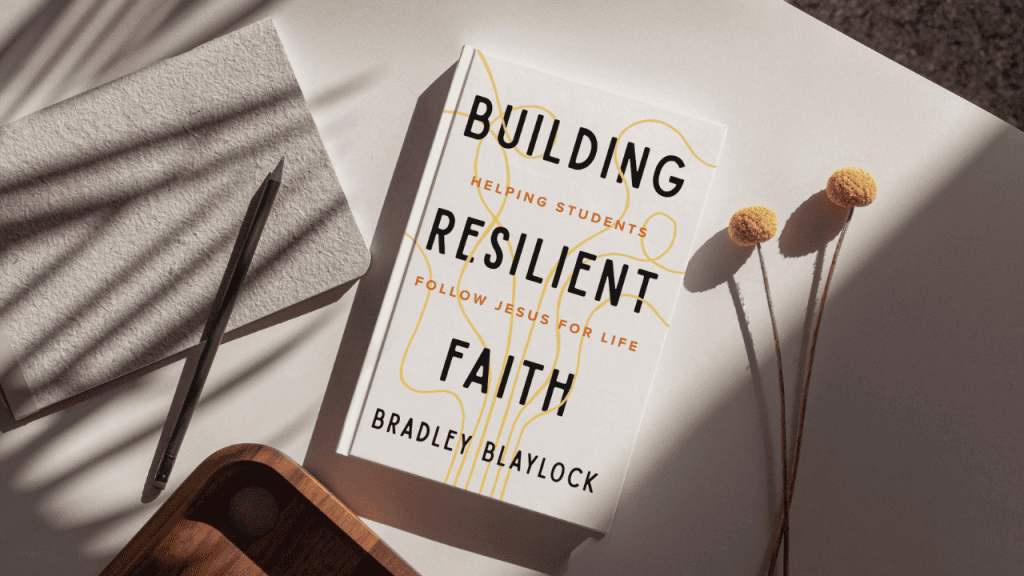
Bradley Blaylock’s book, Building Resilient Faith: Helping Students Follow Jesus for Life, is now available. Published in partnership with New Growth Press and Rooted, this book is a guide for youth pastors and ministry leaders who want to help students develop a strong, enduring, Christ-centered faith that can withstand doubt, cultural pressure, conflicting worldviews, emotional challenges, and life’s inevitable storms.